Licensed & Insured — FL CFC1434216 · 20+ Years Experience · Upfront Flat-Rate Pricing · 12-Month Workmanship Guarantee · Se Habla Español
Cast Iron Drain Pipe Replacement in Davie & Broward County
If your home was built before the mid-1970s, the drains under your floor are probably cast iron — and cast iron fails from the inside out. We run a camera first, show you exactly how much of the pipe has failed, then replace only what needs replacing.
Cast iron was the standard drain material in South Florida homes built before the mid-1970s, and a lot of that pipe is still under the floor in Davie, Cooper City, Plantation, and the older parts of Broward County today. When it went in, it was a good choice — heavy, quiet, and built to take heat. What nobody planned for was what fifty years of Florida soil and South Florida water would do to it.
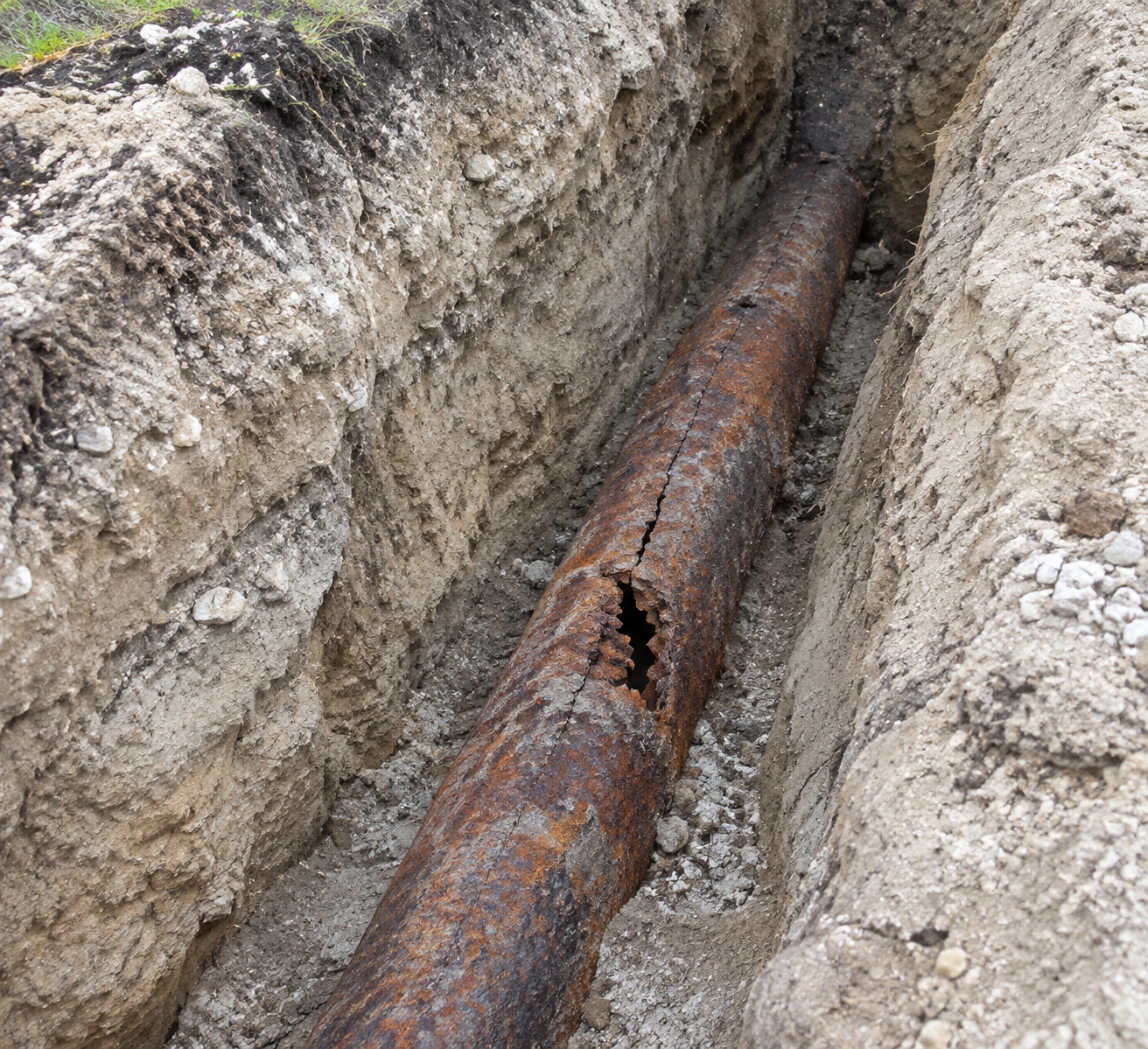
Cast iron fails from the inside out. A drain line does not carry clean water; it carries soap, grease, food waste, and everything else that goes down a sink or a toilet, and that film coats the pipe wall. Underneath the film the iron oxidizes. What builds up is scale — a rough, rusted layer that narrows the pipe and gives waste something to grab onto.
Scale does not wear the pipe evenly. Waste running down the line settles along the bottom, and corrosion follows it, cutting a channel through the pipe's lowest point. Plumbers call that channeling. It is why a cast iron line can still look like a pipe from above while the bottom of it is worn thin and rough. On camera you can see it clearly: the floor of the pipe chewed away while the crown still looks like iron.
Scaling and channeling are only part of it. Cast iron cracks, especially at the hub joints where one length of pipe meets the next, and those joints are also where tree roots get in. Roots grow toward moisture, a weeping joint is moisture, and once roots are inside they catch everything else that comes down the line. That is how a line that was cleaned last spring is backed up again by fall.
The warning signs follow from that. Backups that keep returning no matter how many times the line is cleared. Drains that are slow all over the house at once rather than in one bathroom. Sewer odor in the house or around the outside cleanout. Water rising in the lowest drain in the house when the washing machine empties. On camera, the findings are specific: heavy scale, channeling along the bottom, cracked or separated sections, offset joints, and roots entering at a joint.
What we do about it depends on how much of the pipe has actually failed, and that is a decision we make with the footage in front of you rather than from the driveway. One bad section can be replaced on its own. A run that has failed in several places, or is scaled and channeled along most of its length, is usually better served by replacing the whole run — otherwise you pay for the same access work again in a year. We pull the permits the work requires, document the failed pipe for your insurance claim, and tell you plainly that restoring flooring and finishes is separate work, included only when we have quoted it.
What It Is and When You Need It
Cast iron pipe replacement is the work of taking out a failed drain line and putting a new one in its place, either by tunneling under the slab or by opening a limited section of the floor. It is not the same as clearing a blockage. Cleaning a cast iron line removes what is caught inside it; replacing it removes the pipe that keeps catching things in the first place.
You need to be thinking about replacement when the same line has blocked more than once, when drains are slow across the whole house instead of in one room, when the pipe is already known to be scaled or channeled from a previous camera inspection, or when a camera has found a crack, a separated joint, or a section flattened by roots. Homes on a septic system are no different — the tank is at the end of the line, and the cast iron leading to it ages the same way.
It is also worth knowing when you do not need it. If a camera shows the pipe is worn but intact, and the line has blocked once and cleared completely, cleaning and watching is a fair answer, and we will say so. Replacement is for pipe that has actually failed or is close to it, not for every house that still has cast iron under it.
How We Do It: Camera First, Then the Smallest Repair That Ends the Problem
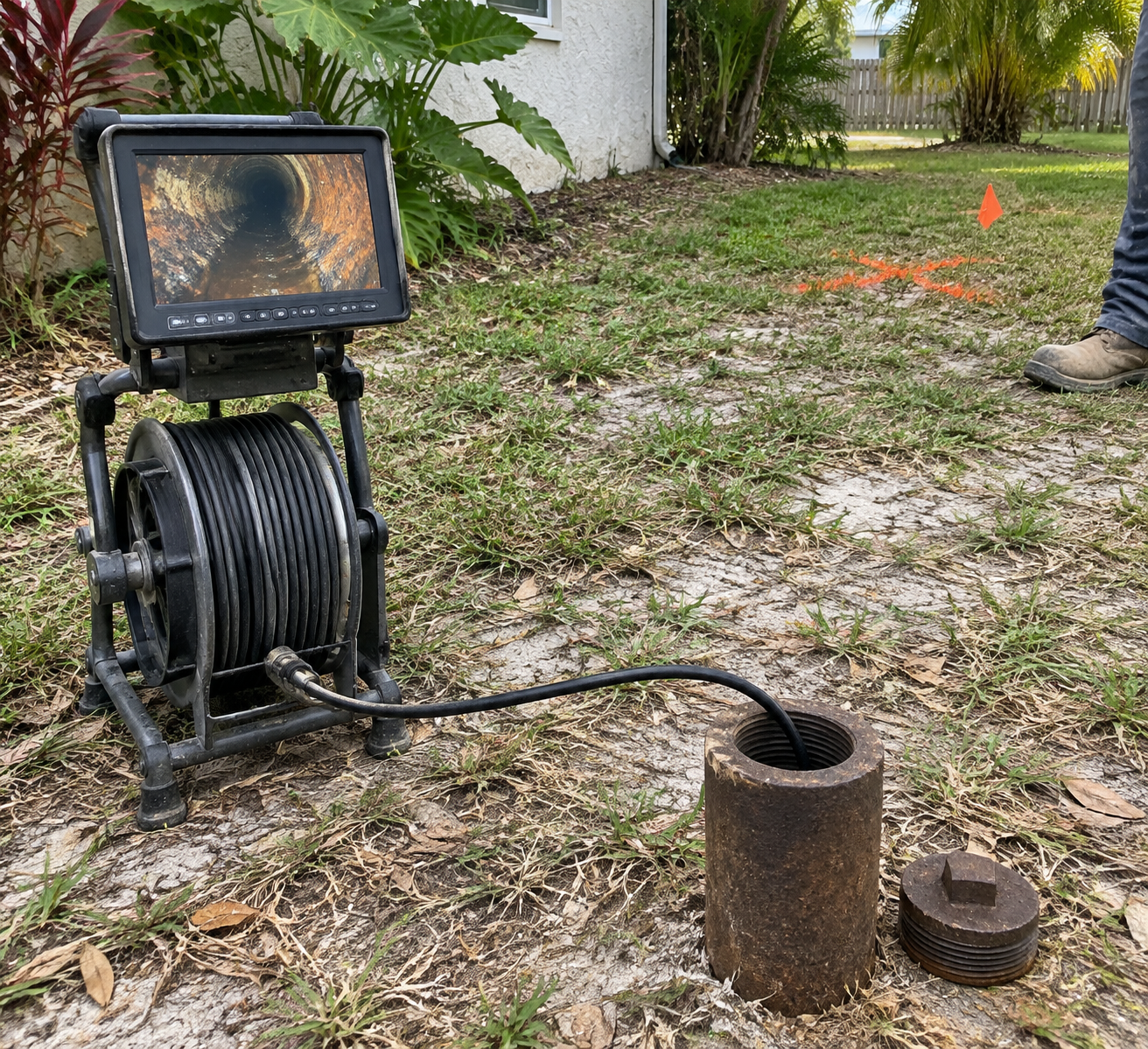
Every cast iron job starts with a camera inspection. We put the camera in at the cleanout, or through a pulled toilet when the home does not have one, and travel the length of the line. You see the screen with us: how much of the pipe wall is left, where the scale sits, where the channel runs along the bottom, where a joint has cracked or separated, and where roots are entering. The camera head carries a locator that lets us mark the run above ground and note the depth of the pipe, so we know what is over it and how deep we will be working.
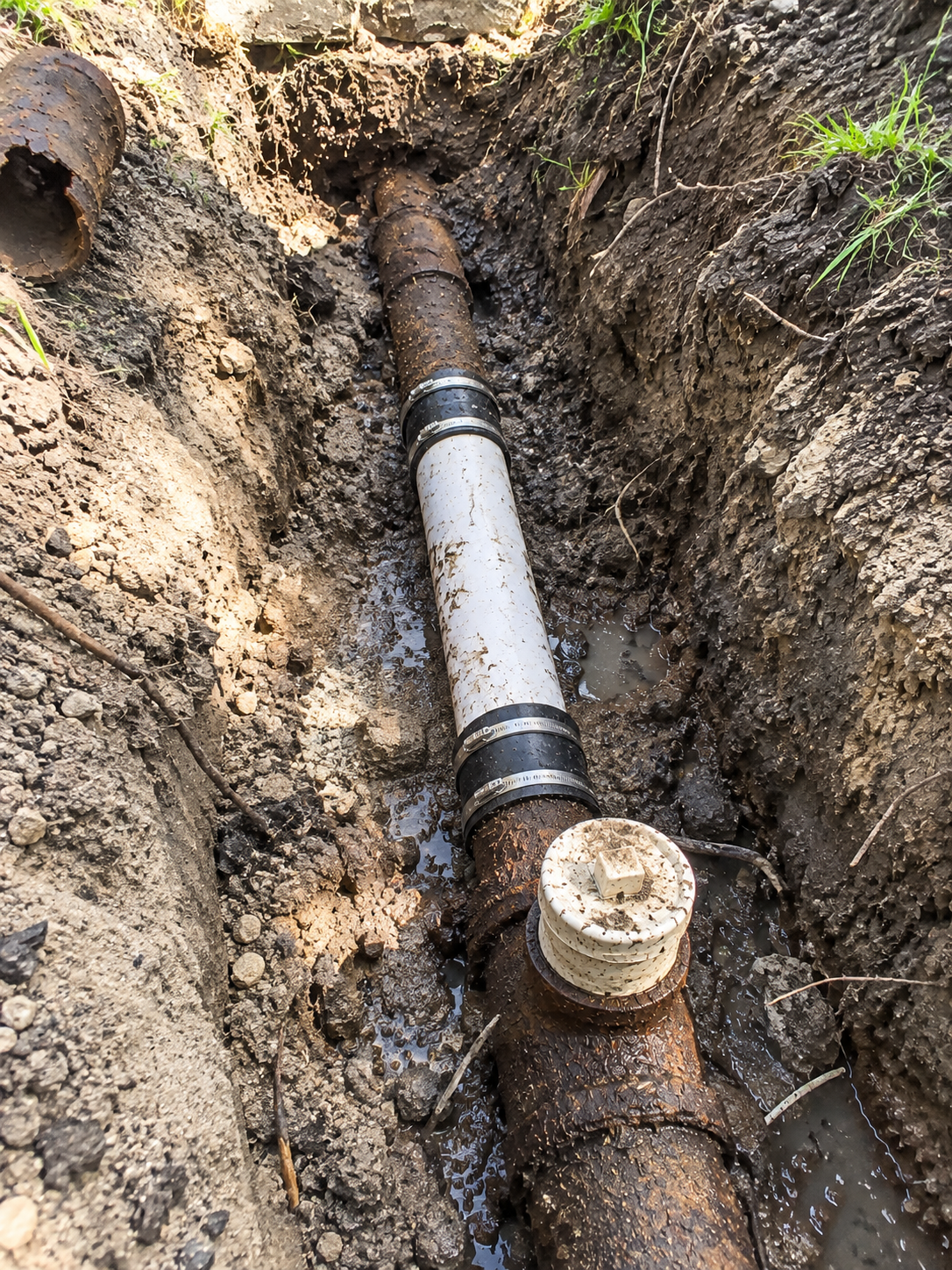
From there we lay out the options in plain terms. A spot repair means cutting out the damaged length — usually from joint to joint, so the new pipe meets sound pipe on both sides — and tying the new section in. It suits a single failure in an otherwise sound line, and it is the least work up front. The honest trade-off is that the rest of the line is still cast iron, and it still has whatever age and scale the camera showed.
A partial replacement takes that idea further: the failed run under the slab gets replaced, while sections that are healthy and reachable stay. This is often the right middle ground in homes where one branch has failed badly and the others have held up — the kitchen line, for example, while the bathrooms are still in good shape.
A full replacement removes the cast iron drain run from the house out to the sewer or septic connection. This is what we recommend when the pipe has failed in several places or is scaled and channeled along most of its length, because the alternative is opening the floor again for the next failure. There are two ways to get at the pipe. Tunneling enters from outside the foundation, works under the slab in the soil, and leaves the finished floor above intact. Cutting through the slab opens the floor along the path of the pipe, which is sometimes the only practical route when the run sits tight against footings or passes under interior walls. Either way the new line is laid to fall, tied into the building drain, and tested before anything is closed up.
Permits, inspections, and what we test before closing up
Replacing drain pipe under a slab is permitted work in Broward County, and we pull the permit and schedule the inspection rather than leaving it to you. The line is tested before it is buried or the slab is patched, so a leak or a bad joint is caught while the pipe is still open instead of after the floor is finished. We keep the job clean, protect the floors we walk on, and leave the site ready for whatever finish work comes next.
Insurance and Restoration
When a failed cast iron line has caused damage in the home, we document what we found: camera footage of the failed pipe, photos, and a written report that notes where the damage is and how deep the pipe sits. That is the evidence an adjuster asks for. Whether your policy covers the pipe, the damage it caused, or any part of the repair is decided by your insurance company, not by us, and we will not promise you an outcome we do not control.
Restoration is separate from the plumbing. Removing and replacing floor tile, engineered wood, carpet, baseboards, cabinets, or paint is a different trade with its own cost, and it is not included in a plumbing quote unless we have written it into the scope. If you want us to coordinate it, ask — otherwise you are free to use your own flooring or restoration company, and we will work around their schedule.
What Affects the Cost
Cast iron replacement is quoted flat-rate after the camera inspection, and the number follows your house rather than a menu. What moves it: how much of the pipe has actually failed, and whether the answer is a spot repair, a partial run, or the full line; the length of the run and how deep it sits below the slab; whether the work can be tunneled from outside the foundation or the slab has to be opened; what sits on top of the pipe — tile, engineered wood, carpet, cabinets, or a tiled shower pan — and how much of it has to come up to reach the run; whether interior walls, footings, or a driveway sit in the path; the condition of the joints and fittings the new pipe ties into, because those may need work too; the permits and inspections the jurisdiction requires and how quickly they can be scheduled; and whether the call came in as an after-hours emergency because the line was backing up into the house.
Restoration is quoted on its own, and if opening the floor reveals something different from what the camera showed, we stop and explain what we found before continuing. Nothing gets added to the bill without your approval.
Why Broward Homeowners Call Us
We are a licensed Florida plumbing contractor, license CFC1434216, based in Davie and working across Broward County for more than 20 years. Cast iron is what a lot of the housing stock here was built with, so it is work we do regularly rather than occasionally. You get a flat-rate price before anything starts, a 12-month workmanship guarantee, permits pulled in our name, and the camera footage handed over instead of kept.
We also tell you when the answer is no. If your camera footage shows pipe that is worn but still holding, replacing it is a decision you can make on your own timeline — not an emergency, and we will say so plainly. If a cleaning will buy you time, you will hear that too. Se habla español, and our 24/7 emergency line is answered live by a person rather than a voicemail box.
Book Cast Iron Pipe Replacement
If your older home keeps backing up, or you have been told the cast iron under your floor needs to go and want to see the evidence first, book a visit and we will run the camera and show you the pipe. If sewage is coming up inside your home right now, call (754) 258-5599 — the emergency line is answered live, day or night.
Cast iron replacement is part of our Repiping & Pipe Replacement in Davie, FL service. Start with a Sewer Camera Inspection if you want to see the pipe before deciding, or Sewer & Main Line Cleaning if the line is blocked right now.
Common Warning Signs
Don't ignore these signs — they usually mean it's time to call a plumber.
How Scheduling Works
Three simple steps from phone call to fixed.
Call or Book Online
Call (754) 258-5599 or use our online booking tool to schedule a time that works for you.
We Arrive On Time
Your licensed plumber arrives within the scheduled window and diagnoses the issue.
Upfront Price, Then We Work
You get a flat-rate quote before any work begins. You approve, we fix it — no surprises.
Service Area
Based in Davie, FL, we serve homeowners across Broward County and South Florida. Same-day service is available for emergencies throughout our coverage area.
Frequently Asked Questions
How do I know if my house has cast iron drain pipes?
Can a cast iron drain be repaired instead of replaced?
Do you have to break up my floor to replace a cast iron drain line?
Will my homeowners insurance cover cast iron pipe replacement?
Does cast iron pipe replacement require a permit?
Related Plumbing Services
See how else we can help with your plumbing.